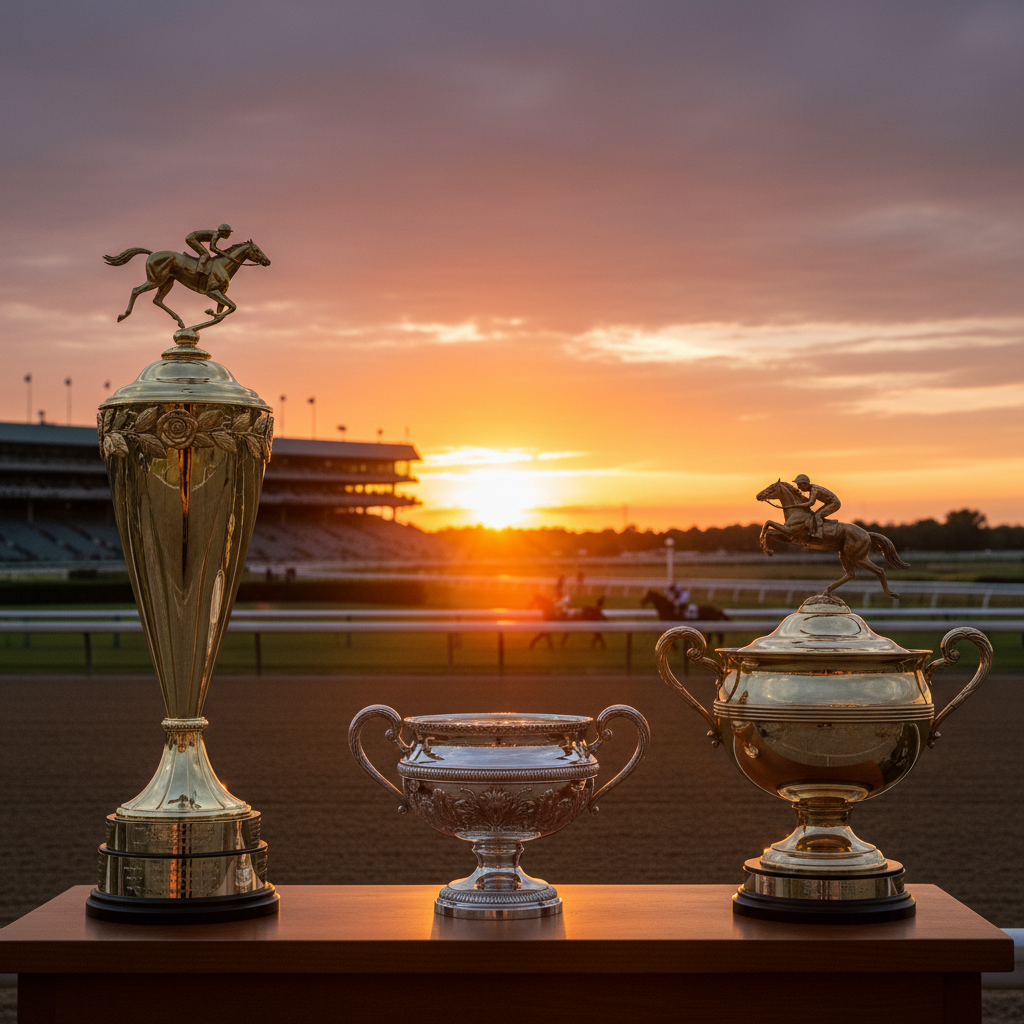
The Triple Crown: Racing's Ultimate Challenge
Three Races, Five Weeks, One Legend
In all of American horse racing, no achievement is more revered than the Triple Crown. Three races. Five weeks. A distance and surface challenge that has tested the greatest horses in history. Only 13 thoroughbreds have ever accomplished it.
The Three Jewels
The Triple Crown consists of three races for 3-year-old Thoroughbreds, run over five weeks in the spring:
- The Kentucky Derby — 1 ¼ miles at Churchill Downs in Louisville, Kentucky. The first Saturday in May.
- The Preakness Stakes — 1 3/16 miles at Pimlico Race Course in Baltimore, Maryland. Two weeks later.
- The Belmont Stakes — 1 ½ miles at Belmont Park in Elmont, New York. Three weeks after the Preakness.
The distances increase with each race. The time between races is tight. And the competition is relentless. Winning all three requires not just talent, but stamina, consistency, and heart.
The Derby: Chaos at Churchill
The Kentucky Derby is the most demanding of the three — not because of the distance, but because of the field size. With up to 20 horses, the Derby is a cavalry charge. Horses are bumped, jostled, and blocked. Traffic trouble is almost guaranteed. A horse that survives the Derby in peak condition has already cleared the highest hurdle.
The Preakness: The Middle Jewel
Two weeks later, the Preakness Stakes tests a different kind of toughness. The field is smaller — typically 8 to 14 horses — and the distance is shorter. But the quick turnaround from the Derby is the challenge. A horse that ran a hard 1 ¼ miles must recover and race again in just 14 days.
The Preakness often sees Derby runners skip the race (known as "bypassing the Preakness"), opening the door for fresh horses. This can be an advantage for newcomers — or a disadvantage if they can't match the class of the Derby winner.
The Belmont: The Test of Champions
If a horse wins the Derby and the Preakness, all eyes turn to the Belmont Stakes — the "Test of the Champion." At 1 ½ miles, it's the longest of the Triple Crown races and the longest dirt race most American horses will ever run.
The Belmont has broken many hearts. The distance exposes any stamina limitation. Horses that won the Derby and Preakness with tactical speed often find the Belmont's grueling distance too much. The race demands a horse that can sustain speed over an exhausting mile and a half.
The 13 Triple Crown Winners
Only 13 horses have swept the series:
- Sir Barton (1919) — The first, though the term "Triple Crown" didn't exist yet.
- Gallant Fox (1930)
- Omaha (1935)
- War Admiral (1937)
- Whirlaway (1941)
- Count Fleet (1943)
- Assault (1946)
- Citation (1948)
- Secretariat (1973) — Ended a 25-year drought with one of the greatest performances in racing history.
- Seattle Slew (1977) — Undefeated through the Triple Crown.
- Affirmed (1978) — The last of the old era, winning the Belmont by a nose over Alydar in one of racing's greatest rivalries.
- American Pharoah (2015) — Ended a 37-year drought.
- Justify (2018) — Won despite not racing as a 2-year-old.
The 37-Year Drought
After Affirmed in 1978, racing went 37 years without a Triple Crown winner. Many came close — Spectacular Bid, Silver Charm, Real Quiet, War Emblem, Funny Cide, Smarty Jones, Big Brown, and I'll Have Another all won the first two legs. Each faltered in the Belmont.
Some lost narrowly. Real Quiet lost the 1998 Belmont by a nose. Smarty Jones was caught in the final strides in 2004. The Belmont earned its reputation as a heartbreaker.
When American Pharoah finally broke through in 2015, the racing world erupted. It was a moment of catharsis for a sport that had waited nearly four decades.
What Makes a Triple Crown Horse?
Winning the Triple Crown requires a rare combination:
- Stamina: The Belmont demands a horse that can run 1 ½ miles without fading.
- Versatility: Each race has a different pace scenario and field size.
- Recovery: Five weeks of racing at the highest level with minimal rest.
- Talent: Simply put, the horse must be the best of its generation.
- Racing luck: Traffic trouble, bad trips, and weather can derail even the most talented horse.
The Breeders' Cup Connection
While the Triple Crown defines the spring, the Breeders' Cup — held in late October or early November — offers a year-end championship. A horse that wins a Triple Crown race and then takes the Breeders' Cup Classic is considered among the best of the year. American Pharoah accomplished this in 2015, cementing his legacy.
A Spring Like No Other
There's nothing quite like Triple Crown season in horse racing. The hope, the heartbreak, the history — it's the most compelling narrative in the sport. Every spring, a new group of 3-year-olds lines up at Churchill Downs, and the dream begins again.
Looking for picks during Triple Crown season and beyond? Visit our picks page for AI-powered analysis across all major US tracks.
Want premium picks with higher confidence?
Upgrade to Premium
